When you see the term “novel food” on a supplement label, it’s easy to assume that it refers to something new, experimental, or only recently discovered.
That is certainly not the case with astaxanthin. This red carotenoid has long existed in nature and can be found in microalgae, salmon, trout, krill, and other organisms.
So why does astaxanthin derived from the microalga Haematococcus pluvialis have Novel Food status in the European Union?
The answer lies in the meaning of the regulatory term itself.
What Does “Novel Food” Actually Mean?
Under European Union regulations, novel food refers to food that was not consumed to a significant degree in the EU before 15 May 1997 and falls within one of the categories defined by the legislation.
In other words, “novel” does not mean that a substance has just been discovered, nor does it automatically mean that it is experimental.
It is a regulatory classification.
Before a novel food can be placed on the EU market, it must undergo an appropriate assessment and authorization procedure. Authorized novel foods and ingredients are included in the European Commission’s official Union List of Novel Foods.
Where Does Astaxanthin Fit In?
It is important to be precise: Novel Food status does not simply apply to “astaxanthin” as a molecule in every possible form.
The EU list includes astaxanthin-rich oleoresin derived from the microalga Haematococcus pluvialis.
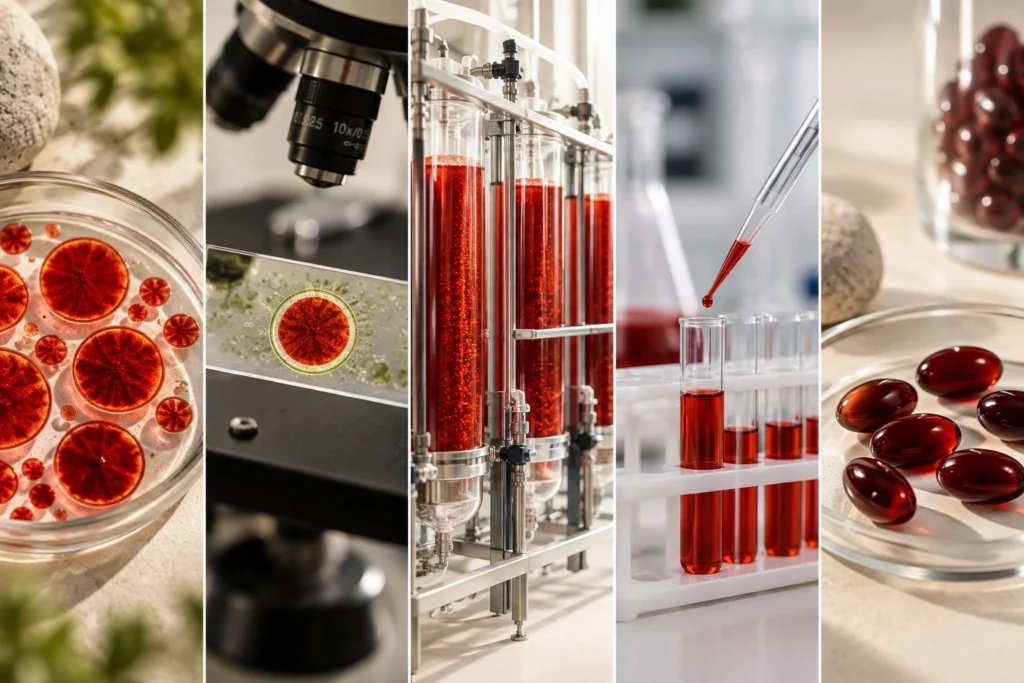
The microalga Haematococcus pluvialis naturally produces and accumulates astaxanthin, particularly when exposed to stressful environmental conditions such as intense light.
After cultivation, the microalgal biomass is harvested and dried, and an astaxanthin-rich oleoresin is extracted. It is this specific ingredient for which EU regulations define specifications, conditions of use, maximum permitted levels, and labeling requirements.

The Regulatory History of AstaPure® Astaxanthin in Europe
The AstaPure® ingredient available today has a regulatory history stretching back almost two decades.
As early as 2007, Algatechnologies submitted an application to the competent authority in the United Kingdom for the assessment of astaxanthin-rich oleoresin derived from the microalga Haematococcus pluvialis, under the European Novel Food Regulation (EC) No 258/97, which was in force at the time.
The procedure focused on assessing the substantial equivalence of this ingredient to an oleoresin derived from Haematococcus pluvialis that was already present on the European market following an earlier Novel Food procedure.
The assessment was not based solely on the fact that both ingredients contained astaxanthin. It also considered their composition, nutritional value and metabolism, intended use, and levels of potentially undesirable substances.
Researchers examined the carotenoid profile, different forms of astaxanthin, fatty acids, and other components. According to the documentation, the results did not reveal significant compositional differences that would call the products’ equivalence into question.
Particular attention was also given to microbiological testing and manufacturing quality control systems. The documentation describes testing for microorganisms and other potential contaminants, as well as the implementation of GMP, ISO 9001, and HACCP systems.
This illustrates how detailed a regulatory assessment can be. It considers not only astaxanthin itself, but also its origin, composition, production methods, quality controls, and intended use.
One interesting detail from the 2007 documentation is that the proposed applications for the AstaPure® ingredient included dietary supplements containing up to 4 mg of astaxanthin per capsule.
Today, each AstaPure® veggie softgel capsule in Alga Vita’s product also contains 4 mg of natural astaxanthin.
Does Novel Food Status Mean Astaxanthin Is Safe?
A more precise way to put it is that authorization means a particular novel food has undergone a regulatory assessment and has been approved for use under defined conditions.
This is an important distinction.
Authorization is not unrestricted approval for any amount of astaxanthin, any product, or any method of use.
EU regulations specify the permitted amounts of astaxanthin from astaxanthin-rich oleoresin derived from Haematococcus pluvialis in food supplements intended for different age groups.
How Much Astaxanthin Is Permitted in the EU?
Under the applicable conditions of use, the maximum daily levels of astaxanthin from this novel food ingredient in food supplements are:
- Ages 3 to under 10: 2.3 mg per day
- Ages 10 to under 14: 5.7 mg per day
- General population over 14 years of age: 8 mg per day
The regulations also establish specific labeling requirements, including a warning that supplements containing this ingredient should not be consumed on the same day as other supplements containing astaxanthin esters, which are forms of astaxanthin bound to fatty acids.
So behind the seemingly simple term “Novel Food” lies a carefully defined regulatory framework.
Why Is 1997 Such an Important Year?
The date 15 May 1997 is not when astaxanthin was discovered or first used. It is the reference date established by European Novel Food legislation.
When a food has no established history of significant consumption in the EU before that date and falls within one of the categories covered by the legislation, it may be subject to Novel Food rules.
This is why something that has existed in nature for thousands of years can still be classified as a “novel food” for regulatory purposes.
In other words, “novel” refers to a food’s history of consumption on the European market, not to the age of the substance itself.
What Is Evaluated in a Novel Food Assessment?
A regulatory assessment looks at much more than an ingredient’s name. Depending on the specific case, it may examine identity and composition, production methods, specifications, proposed uses and intake levels, exposure, and data relevant to safety.
The historical documentation for the Algatechnologies ingredient provides a good example of how detailed such an assessment can be. It examined not only astaxanthin concentrations but also the carotenoid profile, proportions of different astaxanthin forms, fatty acid composition, microbiological quality, potential contaminants, stability, and manufacturing quality control systems.
This is why both the origin of an ingredient and the way it is produced matter.
For astaxanthin-rich oleoresin derived from the microalga Haematococcus pluvialis, EU regulations also define specific compositional requirements. These specifications were further updated in 2024, including provisions relating to the composition of astaxanthin monoesters and diesters.
What Does Novel Food Status NOT Mean?
Perhaps the easiest way to understand the term is to address a few common misconceptions.
“Novel food” does not mean “newly discovered substance.” Astaxanthin has existed in nature for far longer than European food regulations.
Nor does it mean “experimental product.” Authorized novel food ingredients are included on the EU’s official list and have clearly defined conditions under which they may be placed on the market.
At the same time, Novel Food authorization is not proof that an ingredient provides every health benefit attributed to it.
The safety and permitted conditions of use of a novel food ingredient are one regulatory matter, while health claims and evidence of specific effects are another.
This distinction is particularly important when discussing dietary supplements.
What Does This Mean When Choosing an Astaxanthin Supplement?
Novel Food status is another reason not to focus solely on the number of milligrams displayed on the front of a supplement package.
It is important to know where the astaxanthin comes from, what form it takes, who manufactures the ingredient, how its production is controlled, and whether the product complies with the applicable conditions of use and labeling requirements.
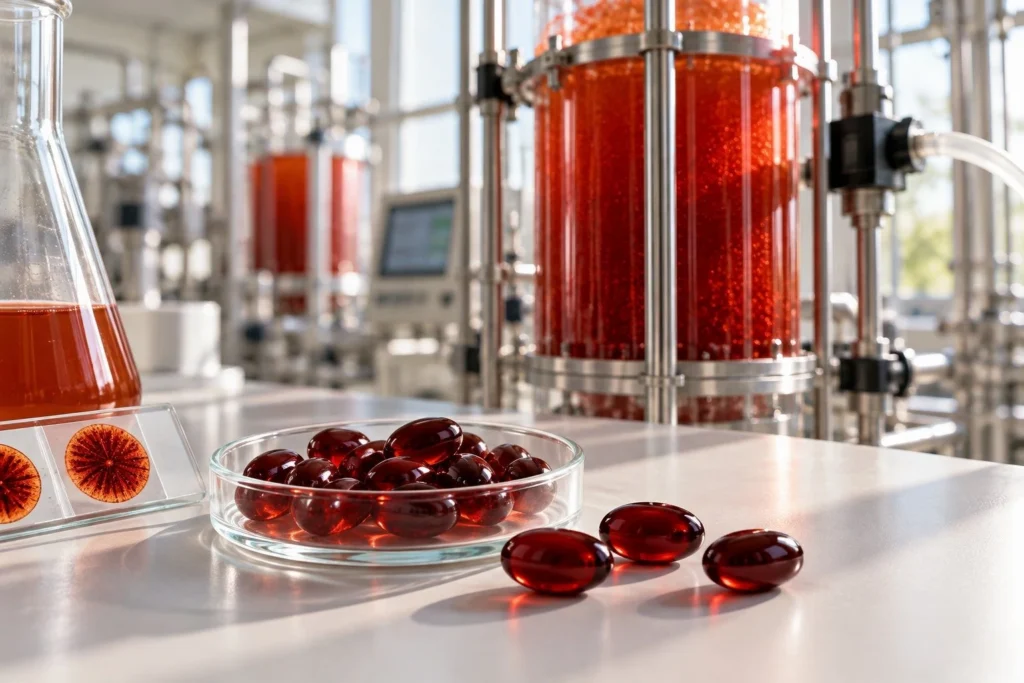
Alga Vita uses AstaPure® natural astaxanthin derived from the microalga Haematococcus pluvialis, with 4 mg of astaxanthin in each veggie softgel capsule.
So the next time you come across the term “Novel Food,” don’t interpret it as “something new and unknown.”
Its actual meaning is much more interesting: a natural ingredient can be as old as nature itself and still be considered “novel” under European food regulations.