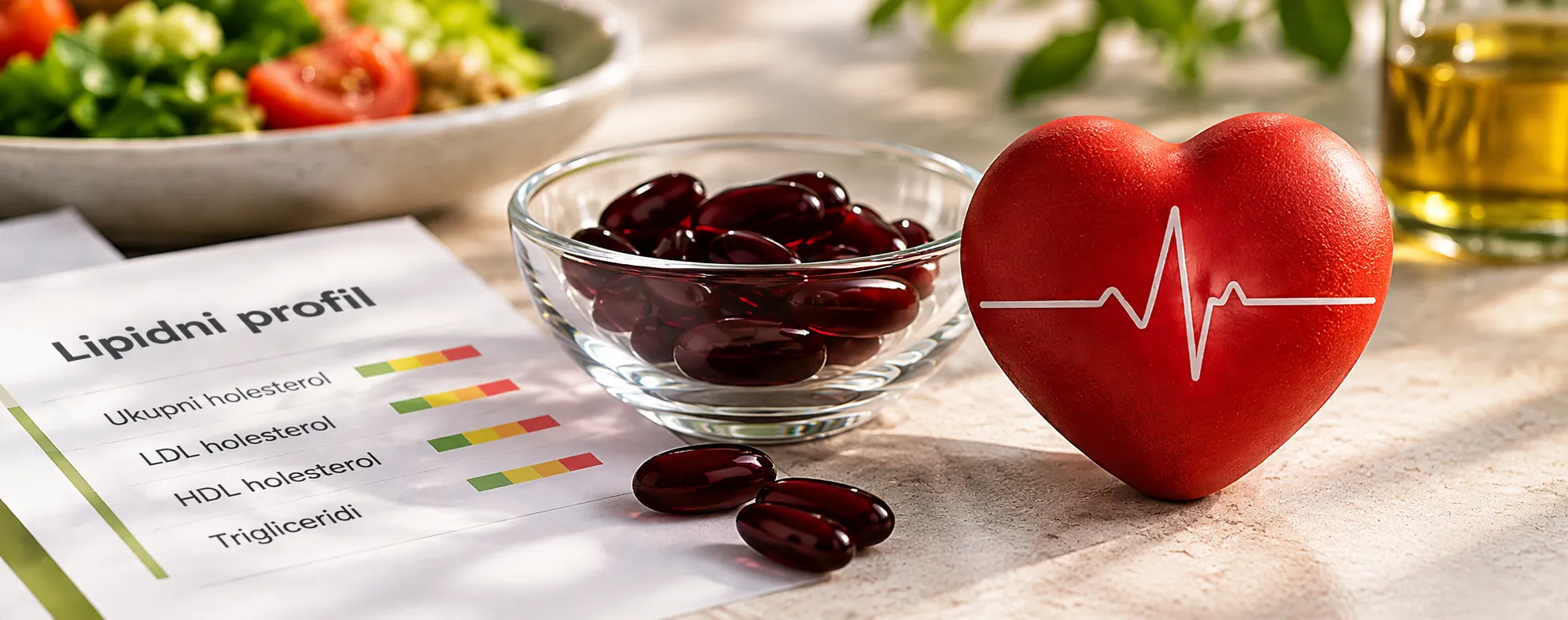
When we talk about heart health, cholesterol is often one of the first things that comes to mind. But cardiovascular health is far more complex than a single number on a blood test. Lipid profiles, oxidative stress, inflammation, blood pressure, and metabolism all play a role in the long-term health of the heart and blood vessels.
In recent years, researchers have also been investigating astaxanthin, a natural carotenoid known for its antioxidant properties. Of particular interest is whether astaxanthin supplementation can influence certain factors associated with cardiovascular health.
The findings are interesting — but the picture is far from straightforward.
Why Is Astaxanthin Being Studied in Relation to Heart Health?
Oxidative stress occurs when the balance between the production of reactive molecules and the body’s ability to neutralize them is disrupted. Prolonged oxidative stress and chronic inflammation are associated with processes involved in the development of cardiovascular disease.
Because of its molecular structure, astaxanthin has been widely studied as an antioxidant carotenoid, prompting scientists to investigate its potential effects on lipid profiles, inflammatory markers, and other cardiometabolic risk factors.
However, it is important to distinguish between a promising biological mechanism and a health benefit that has been reliably demonstrated in humans.
What Do We Know About Cholesterol and Triglycerides?
One of the most frequently cited clinical studies involved 61 adults with mildly abnormal lipid profiles. Over 12 weeks, participants received either a placebo or 6, 12, or 18 mg of astaxanthin daily.
Some groups showed reductions in triglycerides and increases in HDL cholesterol, while no significant changes in LDL cholesterol were observed.
However, a single study is not enough to draw general conclusions.
An earlier meta-analysis of seven randomized controlled trials involving a total of 280 participants found no statistically significant overall effect of astaxanthin supplementation on total, LDL, or HDL cholesterol, or on triglycerides. The authors therefore concluded that larger, better-designed studies were needed.
What Do More Recent Studies Show?
In recent years, the evidence has become somewhat more interesting.
A systematic review and meta-analysis published in 2025 examined randomized controlled trials using moderate to higher doses of astaxanthin.
The results suggested potentially beneficial effects on HDL cholesterol and triglycerides, while no significant effects were found on LDL or total cholesterol.
However, there is an important limitation: the authors rated the certainty of evidence as low for triglycerides and LDL cholesterol, and very low for HDL and total cholesterol, partly because of small sample sizes, differences between studies, and methodological limitations.
In other words, the findings are interesting, but far from conclusive.
What Does the Latest Analysis Tell Us?
In August 2026, a new systematic review was published, covering 16 clinical trials involving a total of 694 adults with overweight or obesity.
In this specific population, astaxanthin supplementation was associated with small but statistically significant improvements in triglycerides, total cholesterol, and LDL cholesterol, as well as increases in HDL cholesterol. Changes in certain markers of inflammation and oxidative stress were also observed.
At the same time, no significant effects on blood pressure or body weight were found.
Caution is still necessary. The authors emphasized that the certainty of evidence was low or very low for several outcomes and called for larger, standardized clinical trials.
So, Does Astaxanthin Lower Cholesterol?
Based on the research currently available, we cannot yet simply claim that astaxanthin “lowers cholesterol.”
More recent findings suggest a possible beneficial influence on certain lipid parameters, particularly triglycerides and HDL cholesterol, but results across studies are not entirely consistent.
It is especially important not to assume that effects observed in some studies will apply to every individual, every dose, or every astaxanthin product.
Astaxanthin should therefore be viewed as an interesting subject of ongoing research into cardiometabolic health, rather than a substitute for cholesterol-lowering medication, a balanced diet, physical activity, or other measures recommended by a healthcare professional.
What Does the Science Tell Us So Far?
Research into astaxanthin and cardiovascular health has progressed in recent years, with new findings providing reasons to continue investigating this field.
The most interesting signals currently relate to lipid profiles, oxidative stress, and inflammatory processes, but the quality of the evidence is not yet sufficient to support definitive conclusions.
This also reflects how we want to communicate about astaxanthin at Alga Vita: without making promises that science has yet to confirm, while paying close attention to what emerging research actually reveals.